Page type: Source-led referenceChecked: 10/9/2026Certainty: Use the cited source and build label
All Guides
Warhammer Survivors Faction Traits: Synapse and Waaagh!
Learn Warhammer Survivors faction traits from Auroch's official video: Tyranid Synapse, the stun opening, and the red-screen warning for an Ork Waaagh!
10/9/2026 Pre-release preview Last updated: 10/9/2026 4 min read
FAQ
What are faction traits in Warhammer Survivors?
Auroch describes faction traits as tabletop-inspired mechanics that give enemy factions distinct behaviors, damage resistances, and other properties. Synapse and Waaagh! are two announced examples.
What does Tyranid Synapse do?
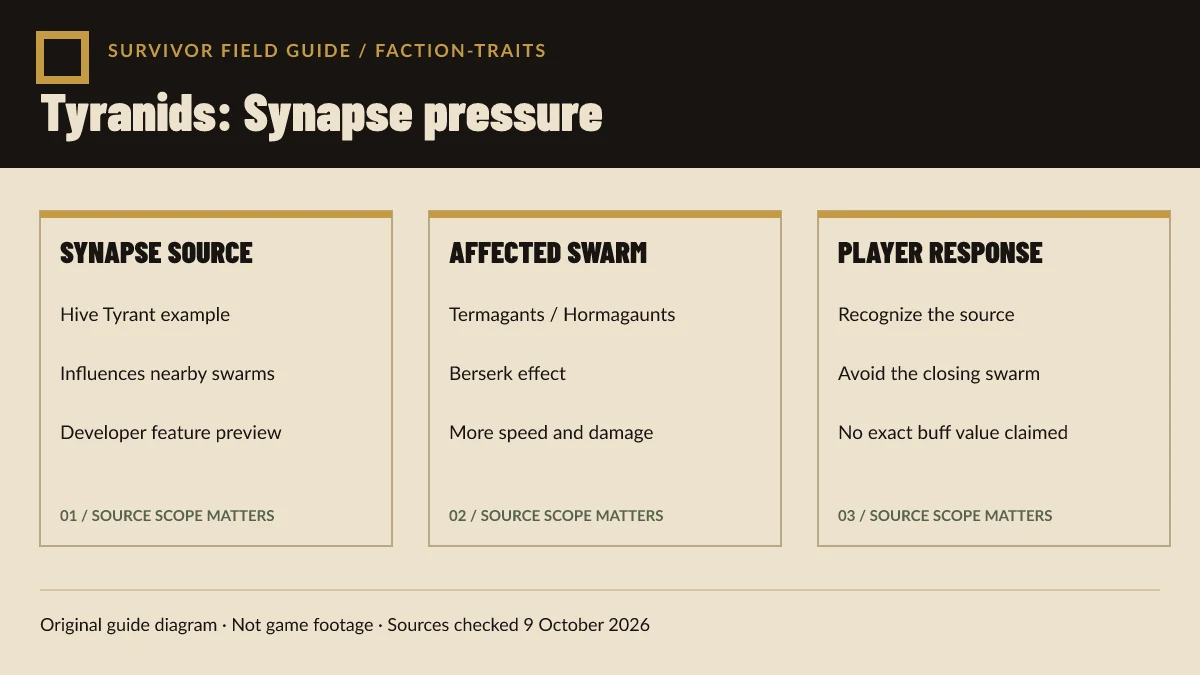
The official preview says critical bioforms such as the Hive Tyrant grant Berserk to nearby Termagants and Hormagaunts, increasing their movement speed and inflicted damage.
What happens when a Synapse creature is destroyed?
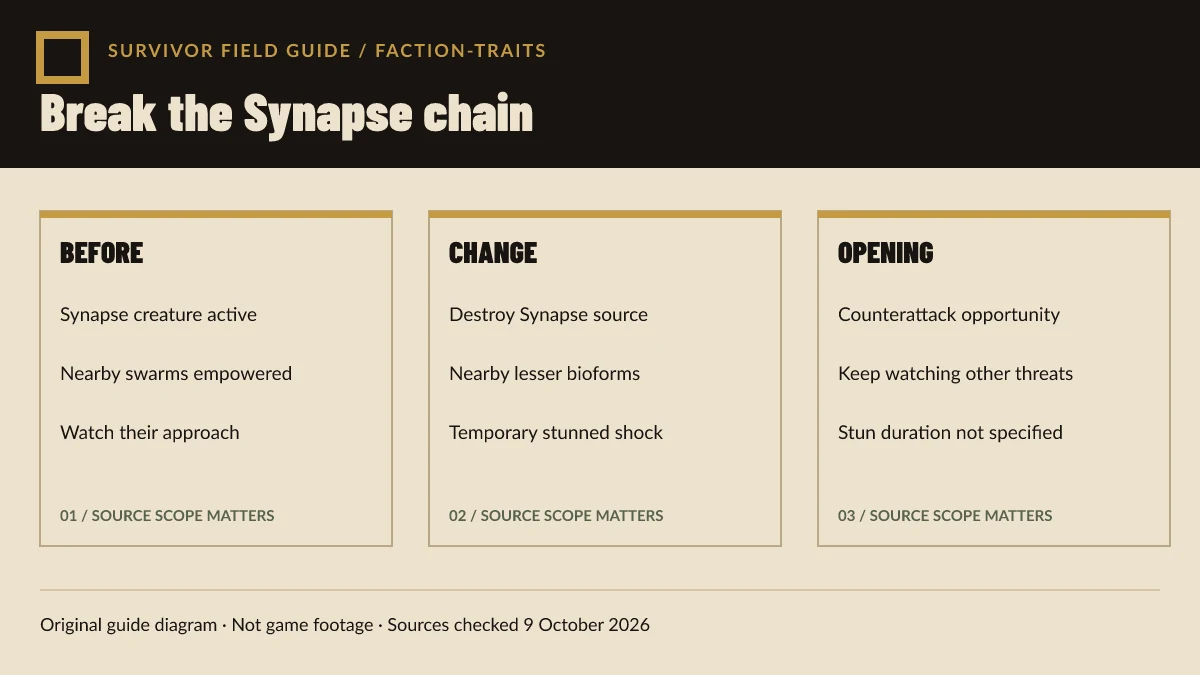
Nearby lesser bioforms enter a temporary stunned shock. Auroch presents this as an opening for a counterattack, without specifying an exact stun duration.
How do I recognize an Ork Waaagh!?
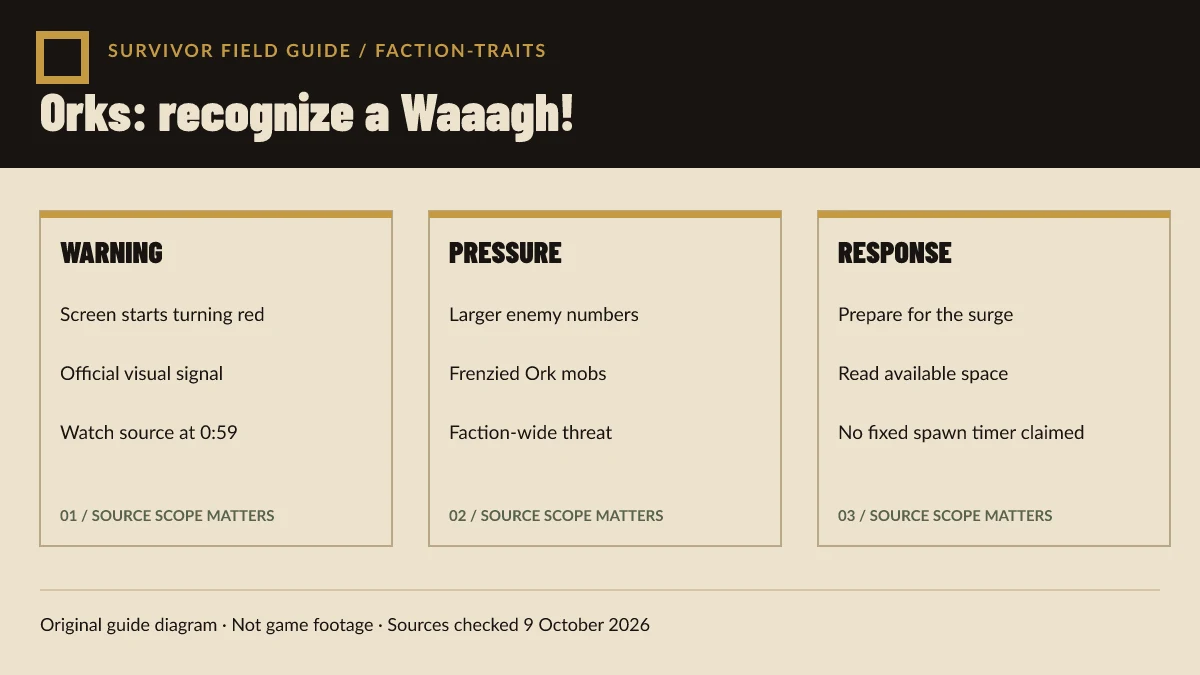
The official faction-traits announcement says the screen starts turning red. The Waaagh! brings greater enemy numbers and frenzied Orks.
Are these all faction traits in the release build?
These are two examples from Auroch's September 17, 2026 pre-release feature demonstration. The video does not establish a complete release-build trait list, exact buff values, or timings.
How do faction traits change an encounter?
Faction traits change how an enemy group behaves, so recognizing the faction can matter as much as recognizing one attack. Tyranid Synapse links a supporting creature to nearby swarms; an Ork Waaagh! signals a larger surge. The three illustrated checkpoints below explain the developer’s examples and provide a direct return to each part of the video.
Source: Auroch Digital, Feature Focus: Faction Traits, published September 17, 2026. Read the matching official Steam announcement. This is an official pre-release demonstration; the October Demo and November release build have not been independently tested here. The illustrations are original explanatory diagrams, with game footage available in the embedded source.
Auroch Digital — Feature Focus: Faction Traits (September 17, 2026)
Which cues should I recognize first?
1. Recognize the Tyranid Synapse source
A Synapse creature changes the threat posed by the swarm around it. Auroch names the Hive Tyrant as an example and identifies nearby Termagants and Hormagaunts as recipients of Berserk. Those enemies move faster and inflict more damage. Recognize the supporting creature as well as the enemies closing on your position; the preview gives no radius, damage percentage, or fixed duration.
The developer explicitly recommends dispatching Synapse-inducing Tyranids quickly. Destroying one causes nearby lesser bioforms to fall into a temporary stunned shock, creating a counterattack opportunity. This is a local response tied to the supporting creature and its surrounding swarm. Keep watching other enemies while using the opening; the announcement does not promise that the entire battlefield becomes safe.
The official Steam explanation identifies a screen turning red as the warning to ready yourself for a Waaagh! During the event, enemies spawn in greater numbers and Orks become frenzied. Treat that cue as a reason to reassess the space around you before the surge arrives. The preview supplies the recognizable warning and behavior, rather than a countdown or a guaranteed spawn schedule.
How are traits different from attacks and status effects?
The trigger is the useful distinction. Synapse and Waaagh! explain pressure from an enemy faction, while a pounce or charge belongs to an individual enemy’s behavior. Berserk is an effect granted within that system. Keeping the trigger, affected units, and result separate helps you interpret the next encounter without assuming every enemy has the same rule.
Question during a run
Guide to use
Which enemy is about to leap, charge, or create a hazard?
For build context, check the May and October Demo guide. The wiki hub connects these mechanic explanations with the other source-backed reference pages.
Source trail
Keep the cited source, build label, and observation date with every factual change. Report a changed claim through the correction route.