
Warhammer Survivors Editorial Standards and Ranking Method
Learn how this wiki labels official announcements, Demo history, community leads, and release observations before publishing a Warhammer Survivors tier verdict.
FAQ
Does a community Demo post prove a recipe?
When can this wiki publish a character tier?
Has this wiki completed a release-build playthrough?
What do the evidence labels mean?
Every factual block should tell a reader what kind of evidence it contains. Official means a developer, publisher, store, or official game announcement says it. Historical Demo means the fact belongs to a dated Demo build and is not silently carried into the full game. Community lead means a player discussion can guide research but has not been independently checked. Observed release means a recorded full-game observation includes its build, platform, date, and reasoning.
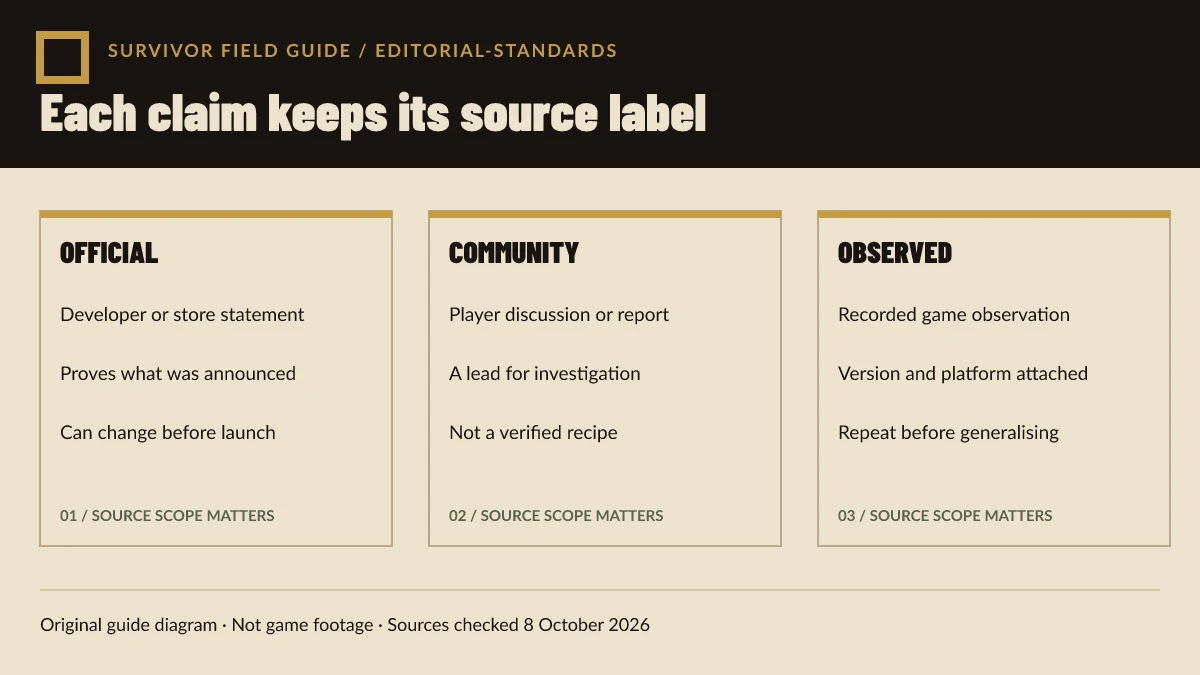
Original informational diagram, not gameplay footage: it explains the evidence labels rather than presenting gameplay results.
| Label | What it can support | What it cannot support by itself |
|---|---|---|
| Official | Announced dates, platforms, named characters, store wording, named relationships | A complete roster, current balance, or an unannounced requirement |
| Historical Demo | What a dated Demo source said or showed | A release-build rank, unlock cost, or guaranteed current recipe |
| Community lead | A question to investigate and a source trail | A verified recipe, statistic, or tier verdict |
| Observed release | A dated, build-labelled gameplay record | A universal conclusion from one unrepeatable run |
This policy is why the evolution chart puts community ingredient pairs in a separate historical research table. It is also why the characters roster preserves the two Lyssa spellings and Yarrick source wording instead of silently rewriting them.
For concrete primary-source examples, compare the official Steam app metadata with the official Steam launch announcement. A store field can establish product scope, while an announcement can establish a dated release or Demo rule; neither one automatically proves a gameplay ranking.
What does a fair future ranking require?
A release-build tier verdict should compare like with like. Set the game build and platform first, record the universe and stage where relevant, and keep the upgrade context comparable. Then observe survival consistency, crowd control and reach, setup requirements, and any evolution or companion relationship that the run actually demonstrates. The point is not to turn one exciting run into a universal grade.
Repeat the comparison enough to explain the trade-offs. Record the hero, starting conditions, item names, trigger or result, observation date, and source. If a mechanic is unknown, label it unknown. If a result changes after a patch, update the affected record and retain the old scope. The homepage’s pre-release tier-list answer links to this method, so future results can be explained without pretending the test has already happened.
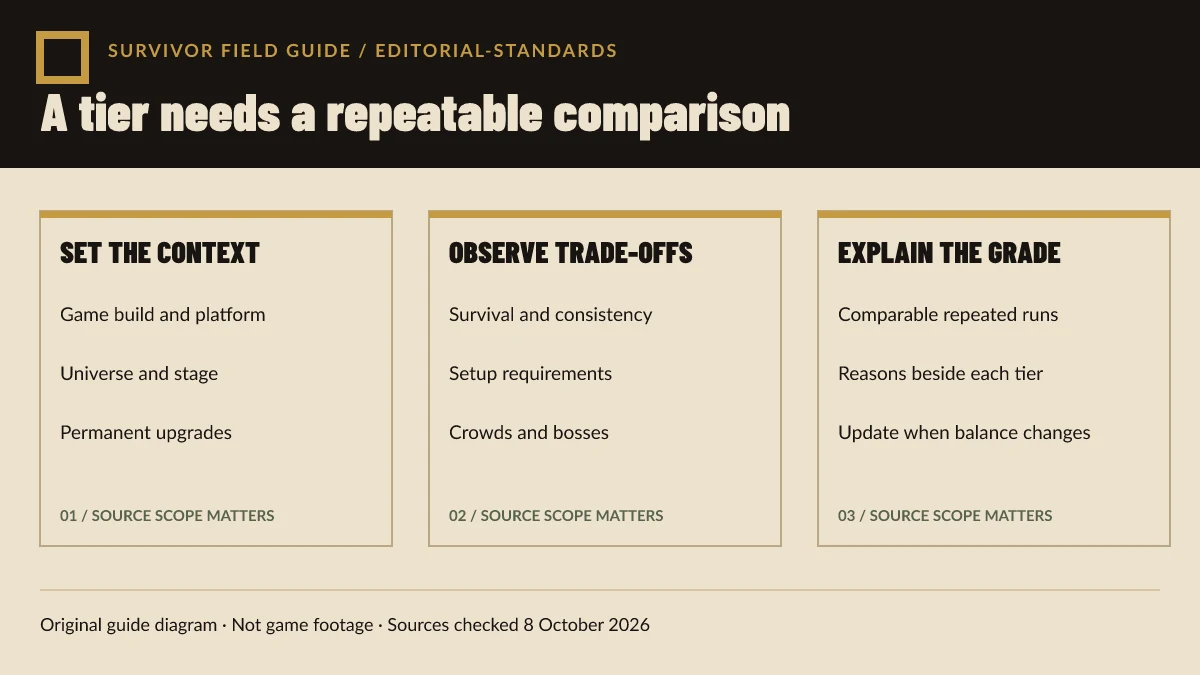
Original informational diagram, not gameplay footage: it describes the future test protocol, not a completed ranking.
What fields belong in a source record?
Use a small, inspectable record for every claim:
- Claim: the exact statement being made.
- Source: URL, publisher, or recorded observation.
- Build and platform: Demo date or release version, plus platform.
- Observation date: when the source or run was checked.
- Certainty: official, historical Demo, community lead, or observed release.
- Reasoning: what the evidence supports and what it leaves open.
- Correction path: where a reader can challenge the claim and what will be rechecked.
The release-date guide uses this approach for platform scope and Demo progress. The mobile guide uses it to keep announced launch platforms separate from unconfirmed device and connectivity details. A missing field is a reason to narrow the wording, not a reason to invent a value.
How are corrections handled?
When a source changes or a reader disputes a fact, identify the page and exact claim, attach the new primary source or build record, and check whether the change affects related pages. Resolve spelling conflicts explicitly instead of creating duplicate entities. Update the date and scope beside the claim, and keep historical Demo wording when it remains useful context.
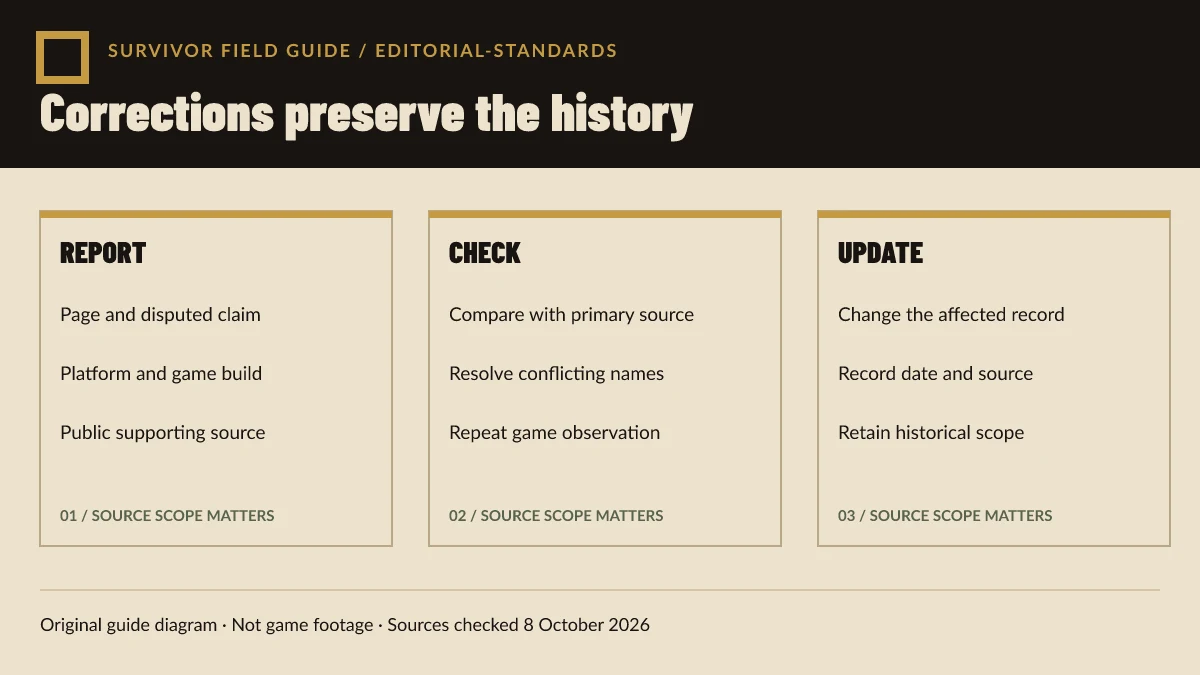
Original informational diagram, not gameplay footage: it shows how a correction changes one record while preserving its history.
No current page should claim a hands-on release tier, complete recipe list, unlock tracker, or player-tested build recommendation. The wiki hub lists the source-backed pages that are ready now. When the November 10 release arrives, these standards give the site a concrete way to decide which records are ready for publication and which still need another check.
Source trail
Keep the cited source, build label, and observation date with every factual change. Report a changed claim through the correction route.
Report a correctionRelated Articles
guides
Warhammer Survivors Enemy Skills: Pounces and Hazards
Recognize Warhammer Survivors enemy skills with Auroch's official video: Leaper pounces, Bloodcrusher charges, Ratling fire, Skaven wards, and toxic clouds.
guides
Warhammer Survivors Faction Traits: Synapse and Waaagh!
Learn Warhammer Survivors faction traits from Auroch's official video: Tyranid Synapse, the stun opening, and the red-screen warning for an Ork Waaagh!
guides
Warhammer Survivors Status Effects: Oil, Fire and Poison
Compare Warhammer Survivors status effects in Auroch's official video: Burning versus Poisoned, Nuln Oil fire synergy, Death Guard poison, and Frenzon.
Was this helpful?
Thanks for the feedback!